
Kitchen Remodeling
Understand the decisions that shape scope, budget and timeline — before you talk to anyone about price.
Get a Free Remodel ConsultationScope
Most kitchen projects fall on one side of a single dividing line: whether plumbing, gas and walls stay where they are. A surface-level renewal — cabinet fronts, countertops, hardware, lighting and paint — keeps the existing layout and is a fundamentally different undertaking from a project that relocates the sink, moves the range or opens a wall.
That distinction drives almost everything downstream: which trades are involved, whether permits and inspections apply, how long the kitchen is out of use, and how much of the budget is committed before anything visible changes. Being clear about which project you actually want is the most useful thing you can do before requesting estimates.
Key Decisions
Moving a sink or range means relocating supply lines, drainage and often gas. In homes built on a slab, that can mean cutting concrete. Keeping the existing positions is frequently the difference between a straightforward project and a structural one.
Refacing, semi-custom and fully custom cabinetry differ not only in cost but in lead time. Custom work is usually ordered early and cannot be rushed later, so it often sets the schedule for everything that follows.
Engineered quartz, natural stone and porcelain slabs look similar in a showroom and behave differently in a working kitchen. Ask specifically about sealing, heat tolerance and how each material handles the way your household actually cooks.
A hood vented to the outside performs differently from a recirculating unit, and high-output ranges raise questions about duct routing and make-up air. This is easy to overlook at design stage and expensive to revisit afterwards.
Older Los Angeles homes were not wired for induction cooktops, double ovens and a full complement of small appliances. Whether the panel has capacity, and what upgrading it would involve, is worth establishing early rather than mid-project.
Which authority reviews the project depends on where you live. The City of Los Angeles is handled by LADBS, while Santa Monica, Pasadena, Beverly Hills and other incorporated cities run their own departments with their own requirements and review times.
Permits
Replacing cabinet doors or counters on the same layout is very different from moving a sink or adding circuits. In the City of Los Angeles, LADBS treats simple kitchen and bathroom remodels as express-permit work that does not need plan check, while moving walls, plumbing or gas lines, or adding electrical circuits, brings plan check. Other cities and the county set their own rules. Confirm what your scope needs before demolition starts, because work done without a required permit can surface later, often when the house is sold.
Fuel and Power
The cooking fuel decision reaches well beyond the range.
Moving from gas to an electric or induction range usually means a new dedicated circuit, and sometimes more capacity at the main panel. Ask whether the panel can carry it before choosing the appliance.
Keeping a gas range means the gas line, the shut-off and the range hood still have to suit the new layout. If the range moves, the line moves with it.
A hood that vents outside needs a duct path through a wall or roof. In a single-story house that is often simple; under a second floor it may not be. Settle the route early, because it can decide where the range can go.
Living Through It
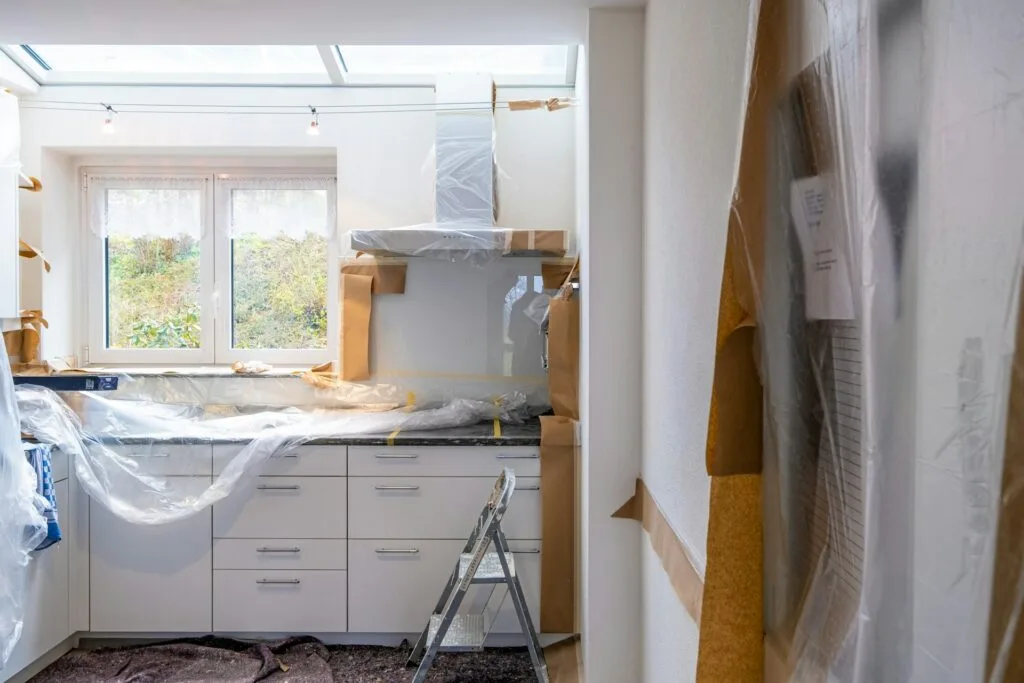
Most households live at home through a kitchen remodel, so plan the temporary kitchen as part of the job: where the refrigerator goes, which sink is used for dishes, and where a counter appliance can run safely. Agree with the contractor which rooms stay off-limits and how dust is kept out of them.
Ask before you commit: has the permit scope been confirmed for the final layout, and can the electrical panel support the appliances you plan to buy?
Before You Commit
Our guide to comparing remodeling estimates covers how to read two proposals that appear to describe the same project but do not.
Share the space, your priorities and your timing. We will talk through what is realistic and what to ask before you commit to anything.
Astrid Lind by Jacob Construction is the design studio of Jacob Construction Inc., a licensed California general contractor (CSLB #1073757). Jacob Construction Inc. performs the work under a written contract with you.
Start the ConversationAreas We Serve
Encino · Sherman Oaks · Studio City · Calabasas · Northridge · Porter Ranch
Astrid Lind by Jacob Construction is the design studio of Jacob Construction Inc., a licensed California general contractor, CSLB License #1073757 (Class B – General Building). All construction work is performed by Jacob Construction Inc. under a written contract signed directly with you. Verify our license at cslb.ca.gov.
We use Google Analytics to count visits and see which pages are useful. We set no advertising or tracking cookies. See our Cookie Policy and Privacy Policy.
Astrid Lind by Jacob Construction · 7077 W Willoughby Ave, Los Angeles, CA 90038 · (424) 256-5005
Astrid Lind by Jacob Construction is the design studio of Jacob Construction Inc., a licensed California general contractor — CSLB License #1073757, Class B (General Building). Design consultations and project estimates are free and carry no obligation. All construction work is performed by Jacob Construction Inc. under a written home improvement contract signed directly with you.
Verify our license, bond and workers’ compensation insurance with the California Contractors State License Board: License #1073757 at cslb.ca.gov or 1-800-321-CSLB (2752).
Any figure, range or timeline shown on this site is preliminary and non-binding. A binding price comes only in a written home improvement contract that complies with California Business and Professions Code §7159, issued after we inspect the property. Nothing here is professional, engineering, architectural or legal advice.
Some images on this site are computer-generated visualisations produced to illustrate design concepts. They are illustrative and do not depict a specific completed project unless the caption says so.